Milky Way Photo Gallery

The Milky Way is a hazy band of light that encircles the night sky. To the ancients it looked like milk had been spilled across the heavens which is why the Greeks called it the galaxies kuklos or milky circle. Greek philosophers Anaxagoras (ca. 500–428 BC) and Democritus (450–370 BC) believed the Milky Way consisted of distant stars. Galileo proven them right in 1610 when he turned his simple telescope skyward and discovered the Milky Way was composed of a countless faint stars.

In the 1750s, Immanuel Kant speculated that the Milky Way was an enormous system of stars held together by gravity and rotating about a common center. From our perspective inside the Milky Way, the resulting disk of stars would be seen as a band of light arching across the sky. Kant even suggested that some of the nebulae visible in astronomer's telescopes are distant, separate star systems themselves, similar to the Milky Way and he called them "island universes".

It wasn't until the 1920s that Edwin Hubble conclusively demonstrated that the Milky Way was actually a "spiral nebula" or galaxy (from the Greek galaxies kuklos) resembling the Great Andromeda Galaxy (M31). The major difference is that our own Solar System resides within the Milky Way Galaxy. This gravitationally bound spiral disk of some 100 billion stars has a diameter of 100,000 light years and a thickness of 10,000 light years. The gas, dust and stars in the Milky Way Galaxy are organized in a bar-shaped core surrounded by a disk of curved arms that follow logarithmic spirals like a nautilus shell. These spiral arm structures are easy to see in external galaxies like the Whirlpool Galaxy (M51).

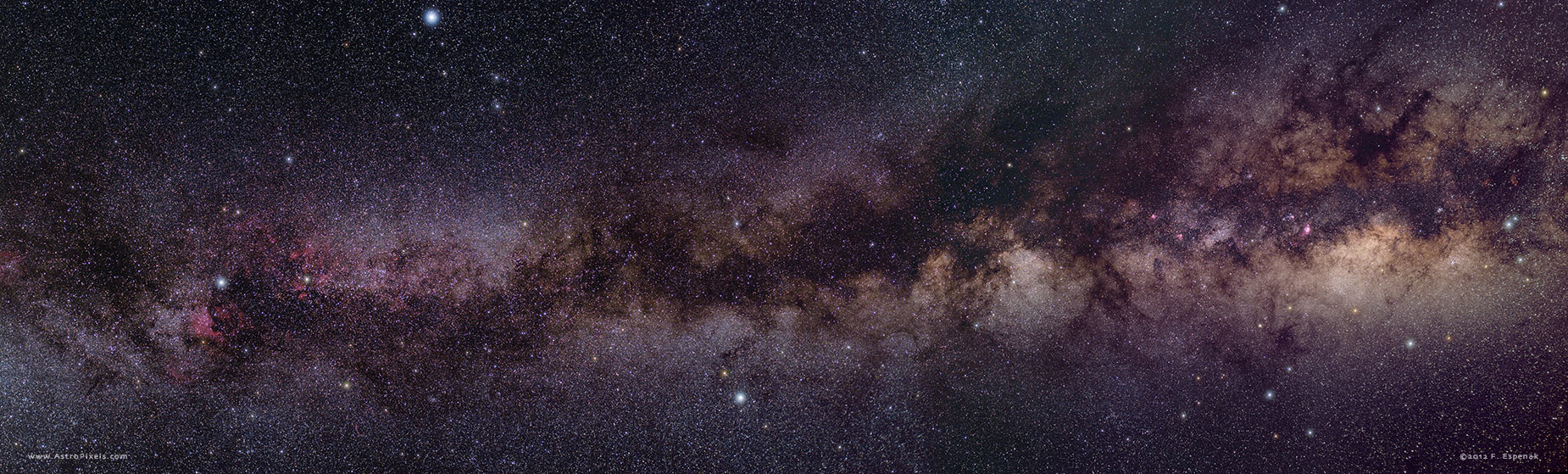
The artificial lights and resulting light pollution of modern cities makes it impossible to see the Milky Way from metropolitan areas. But travel to a remote area with truly dark skies and the Milky Way is revealed as an amazing band of light running across the sky through some of the brightest constellations (e.g. - Taurus, Orion, Carina, Crux, Scorpius, Sagittarius, Aquila, Cygnus, Cassiopeia). Below is a selection of photographs of the Milky Way taken from the dark skies of Portal, AZ.

Milky Way - Panoramas

Milky Way Panorama
Milky Way Panorama - 1
(Bifrost Observatory)

Milky Way Panorama
Milky Way Panorama - 3
(Bifrost Observatory)

Milky Way Panorama
Milky Way Panorama - 2
(360° Horizon)


Milky Way - Mosaics

Milky Way Mosaic
Milky Way Mosaic - 1
Sagittarius Through Scutum

Milky Way Mosaic
Milky Way Mosaic - 2
Scutum Through Vulpecula

Milky Way Mosaic
Milky Way Mosaic - 3
Aquila Through Cygnus

Milky Way Mosaic
Milky Way Mosaic - 5
Sagittarius Through Cygnus


Milky Way - Extreme Wide Angle

MilkyWay12-506m
Milky Way Above
Chiricahua Mtns - 1

MilkyWay12-501m
Milky Way Through
Summer Triangle - 1

MilkyWay12-404m
Milky Way Through
Sagittarius & Scorpius

MilkyWay12-514m
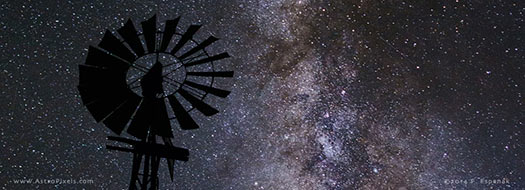
Milky Way Above
Chiricahuas & Bifrost - 1

MilkyWay12-513m
Milky Way Above
Bifrost Observatory - 1

MilkyWay12-522m
Milky Way Above
Chiricahuas & Bifrost - 2


Milky Way - Wide Angle

MilkyWay12-407m
Milky Way Through
Summer Triangle - 2


Milky Way - Telephoto Narrow Angle

MilkyWay12-515m
Milky Way Through
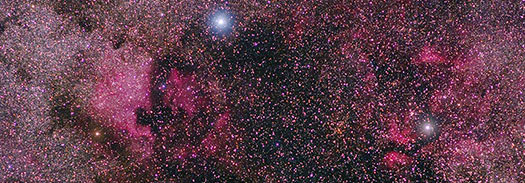
Northern Cygnus


Milky Way Through Constellations

Aql-01
Aquila
The Eagle

Cyg-01
Cygnus
The Swan

Sgr-01
Sagittarius
The Archer

Sco-01
Scorpius
The Scorpion

Milky Way - Wide Angle Mosaics


AstroPixels Links

| Conjunctions Gallery | Moon Photo Gallery | Moon Phases Photo Gallery |
 | 
Constellations Photo Gallery | 
Constellations List | 
Bright Stars Gallery | 
50 Brightest  Stars List | 
 | 
Open Clusters | 
Globular Clusters | 
Diffuse Nebulae | 
Planetary Nebulae | 
Supernovae | 
Galaxies | 
 | 
Messier Catalog Photo Gallery | 
Messier Catalog | 
Caldwell Catalog Photo Gallery | 
Caldwell Catalog | 
 | 
AstroPixels Photo Index |